Modelling and Searching Networks
Winter 2018

Instructor: Dr.
Anthony Bonato
Time and location:
AIMS Cameroon, February 26 - March 16 (inclusive)
Course
outline Lecture, quiz, and assignment schedule
Lecture notes: Lecture 1,
Lecture 2, Lecture 3,
Lecture 4; Lecture 5;
Lecture 6; Lecture 7;
Lecture 8;
Course description: This
is a course on modelling and searching networks. In the first six weeks we will
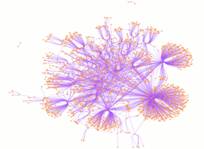
focus on modelling networks, with an emphasis on the emerging theory of complex networks. The study of complex networks analyzes
graph-theoretical properties arising in real-world networks arising in technological,
social, and biological contexts. Web pages and their links, protein-protein
interaction networks, and on-line social networks such as Facebook and LinkedIn
are some of the commonly studied examples of such networks. After an
introduction to complex networks and their properties, we will focus on the
analysis of several models simulating their evolution such as the preferential
attachment model, copying model, geometric models, and the iterated local
transitivity model. The second half of the course focuses
on graph searching. Graph searching is a hot topic in mathematics and computer
science now, as it leads to a wealth of beautiful mathematics, and since it
provides mathematical models for many real-world problems such as eliminating a
computer virus in a network, computer games, or even counterterrorism. In all
searching problems, there is a notion of searchers (or cops) trying to capture
some robber (or intruder, or fugitive). A basic optimization question here is:
What is the fewest number of searchers required to capture the robber? We focus
on the game of Cops and Robbers, and delve into discussion of properties of the
cop number of a graph, retracts, and Meyniel's conjecture. While material will be presented
mostly in a traditional lecture format, some lectures will
include experiential components: students will work in small groups and present to the class
solutions. Audience: All students interested in Mathematics
and its applications. Prerequisites: An
undergraduate degree in Mathematics. Some background in discrete mathematics
and probability would helpful, but not required. Text: None. Three recommended texts are the
following: A.
Bonato, A Course on the Web Graph,
American Mathematical Society Graduate Studies Series in Mathematics,
Providence, Rhode Island, 2008. A.
Bonato, R.J. Nowakowski, The Game of Cops
and Robbers on Graphs, American Mathematical Society, Providence, Rhode
Island, 2011. A.
Bonato, P. Pralat, Graph Searching Games
and the Probabilistic Method, CRC Press, 2017. Anthony
Bonato's web
page.
Lecture 9;
Lecture 10; Lecture 11;
Lecture 12